Facilities Staff Orientation and Desk Manual
- Capital Allocation and Monitoring
- Capital Budget Development
- Capital Budget Request
- Emergency Capital Funding
- Facilities, Infrastructure and Equipment Assessments
- Major Project Status Reports
- Facility Condition Survey Reports - Current
- Facility Condition Survey Reports - Archive
- Sustainability and Energy Conservation
- Megamation DirectLine
- Facilities Staff Orientation and Desk Manual
The community and technical colleges' capital budget request reinforces the State Board's strategic direction.
Orientation and Desk Manual
Version 1.0 | April, 2026
Overview
The WA State Board for Community and Technical Colleges is accountable to the Legislature for the condition, use, and investment in state-owned community and technical college facilities. State Board capital staff support the Board in carrying out that responsibility by coordinating capital planning, approving capital actions, making funding allocations, and ensuring that projects align with system priorities, legislative direction, and state requirements.
From a college perspective, capital projects are not standalone campus initiatives. Even though projects are conceived and delivered locally, they are part of a statewide system of facilities under State Board oversight. State Board capital staff do not manage individual projects day to day, but they play a central role in reviewing capital project proposals, authorizing expenditures, allocating funding, and helping colleges navigate the requirements that come with public funding and state ownership.
College facilities directors play a fundamental part within this structure. College staff are key asset managers and must identify facility needs through master planning, facility condition assessments, and operational experience, and those needs are translated into project scopes, cost estimates, and schedules. The facilities director and assigned or designated staff serve as the campus expert and primary steward of the college’s physical assets, responsible for bringing forward well-defined capital proposals for system consideration. Once a project is approved, the facilities director serves as the owner’s representative for the college, guiding the project from planning through completion (see public work section), managing consultants, tracking budgets and schedules, and ensuring the completed project meets campus needs.
Ongoing coordination is a core expectation of the role. Facilities directors are responsible for maintaining accurate facility and project information and for communicating regularly with State Board capital staff. When scope changes, budget pressures, real estate issues, or unusual conditions arise, early coordination is essential. These conversations help avoid delays, rework, or compliance issues and allow the State Board to exercise its oversight role while supporting colleges in delivering projects.
The State Board for Community and Technical colleges carries the responsibility (RCW 28B.50.090) to prepare and submit a single, system-wide capital budget request to the Legislature each budget cycle, to allocate such funds according to the final state budget, and to ensure that said allocations are expended as directed by the Legislature.
The Legislature appropriates capital funding on a biennial basis for minor works (preservation and program renovations), major capital projects (new construction or major renovation), and alternative financing authorities.
Once enacted, capital appropriations are allotted to the State Board by the Office of Financial Management (OFM) based on project phase and progress, then allocated through the State Board to the colleges. Colleges are required to report expenditures to the State Board and to use the Department of Enterprise Services for public works contracting and capital project implementation.
The State Board for Community and Technical Colleges:
- Owns all property – RCW 28B.50.090 (15)
- Reports all expenditures - RCW 28B.5O.O9O (7)(b) & (14)
- Submits a single prioritized budget request - RCW 28B.50.090 (1)
- Allots funds from OFM and allocates them to the colleges - RCW 43.88.110 & RCW 28B.50.090 (2)
- Approves all capital and real estate projects (WAC Chapter 131-24)
State Board Policy Manual-Chapter 6: Capital Expenditures and Real Property Transactions provides the policy and links to related, procedure, and guidelines.
The ctcLink Accounting Manual (CLAM 30.20 Capital Project Approval Process) provides additional supporting details on capital planning and expenditures.
As state agencies, all colleges must follow multiple layers of state processes and procedures when implementing capital or real estate projects. Capital and real estate projects may require consultation or partnership with the Attorney General’s office, State Treasurer’s office, the Office of Financial Management (OFM), the Department of Archaeological and Historic Preservation (DAHP), and/or local Tribal government.
The community and technical college system has long focused upon responsible and pragmatic capital planning. Each college’s capital facilities should:
- Support it’s part of the system mission;
- Be maintained to extend useful life;
- Be consistent with college master plans;
- Not exceed the college’s needs.
Active engagement with the SBCTC Capital Budget team can help clarify rules, processes, and history that aren’t always apparent to new staff. The team supports colleges with:
- Preparation of budget requests, capital allocations, authorization, monitoring, and technical assistance for capital projects and expenditures;
- Facility Condition Assessments;
- Real property acquisitions, sales, leases, and encumbrances;
- Compliance with state standards and requirements;
- Utilization of 25Live scheduling software, Megamation DirectLine computerized maintenance management system, and data management for external reporting databases.
The State Board team also responds on behalf of the CTC system to analytical requests from the Legislature, the Office of Financial Management (OFM), and other state agencies.
Colleges are required to maintain active communications with the Capital Budget team on:
- Capital expenditure planning, tracking, and project status;
- Real property planning and transactions;
- Requests for information originating from the SBCTC team;
- Physical asset and space inventories;
- Compliance with the state’s Clean Buildings Performance Standard, Refrigerant Management Plan, State Agency Energy Benchmarking and Greenhouse Gas Emissions reduction goals;
- Updates to Campus, Facilities, or Infrastructure Master Plans.
Washington State fiscal years run from July 1 to June 30. Budgets are planned and allocated on a 2-year biennial cycle, with intervening supplemental budget adjustments midway through the biennium.
Biennia begin (and end) in odd numbered years. Biennial capital budget planning will begin each odd numbered year, to be finalized in the following even numbered year for submission by August. Legislative sessions begin the following January. Final budgets are normally confirmed by May and become effective on July 1, at the beginning of the fiscal biennium.
The intervening supplemental year budget requests commonly repeat priorities that were not funded in the biennial request and seldom include new capital requests.
System-wide capital planning and project prioritization is led by the WACTC Capital Committee. The Capital Budget team coordinates, organizes, and supports the single CTC system budget request, ensuring alignment with budget planning and submission requirements issued by OFM for each planning cycle. The CTC system currently has a large backlog of major capital projects (buildings) and new projects are limited within strict guidelines.
The State Board practice is to prioritize minor works ahead of major projects in each capital budget and to request full design and construction funding within a single biennium wherever feasible.
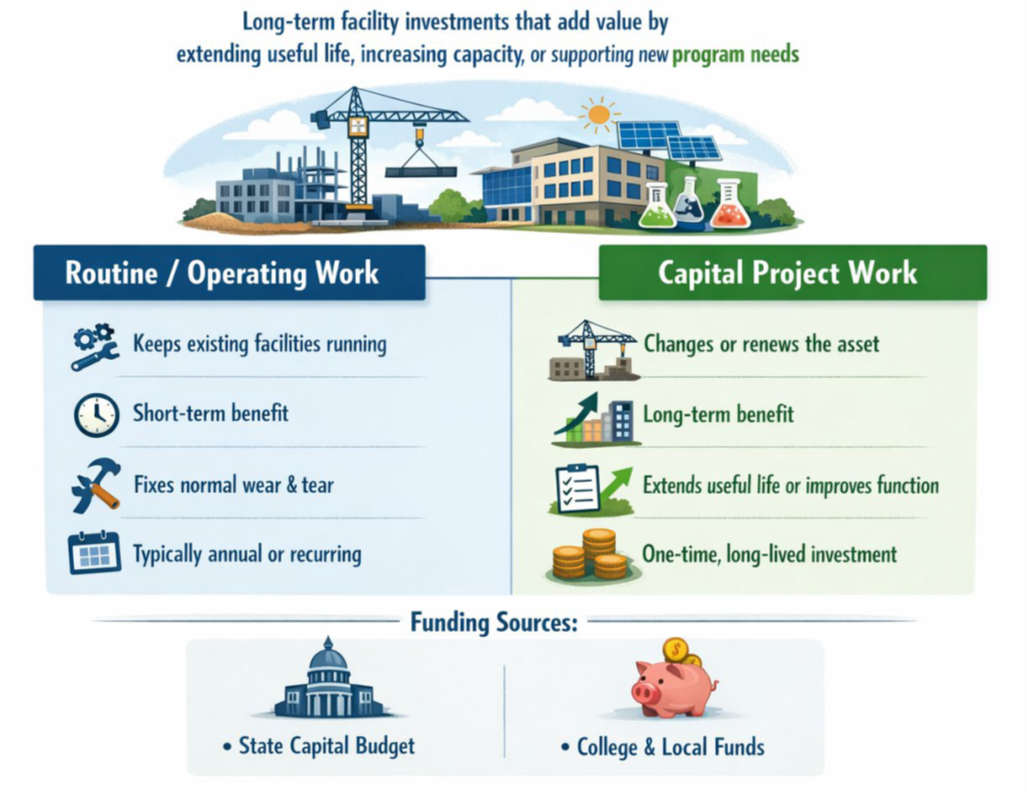
Capital funds fall into three categories: appropriated, non-appropriated, and financed. CLAM 30.10 Types of Funding describes the types of funding, the spending authority, and duration for each.
State (appropriated)
The most common funding provided by the Legislature is from state general obligation (GO) bonds available within the state’s debt ceiling and building/tuition fees (Fund 060) collected by the colleges and sent to the Treasurer’s office. All state funds are constrained for specific purposes, defined both in policy and each specific budget appropriation.
Local (non-appropriated)
Local funds include operational revenues, grants, donations, and other external sources.Once the Legislative capital budget has passed and is signed by the Governor, the official spending authority process passes through OFM to the State Board then out to our colleges.
- SBCTC submits capital budget requests to the Legislature.
- The Legislature defines and agrees upon the State’s capital budget appropriations.
- The Governor approves and legalizes the Legislature’s budget (appropriations).
- The State Board then approves the use of those appropriations.
- SBCTC requests spending authority (allotments) from OFM.
- OFM issues spending authority allotments to SBCTC.
- SBCTC allocates individual college project funds across the system.
Appropriations are enacted legislation signed by the governor that provides the legal authority to spend the defined funds.
The authority to spend the state funds is always defined for a specific purpose, amount, and time period. For Capital projects the appropriations may be used for construction, renovation, and acquisition. Some major capital project funding may cross biennia. Minor works funds are seldom authorized to extend beyond the biennial cycle and require specific reappropriation steps to secure funds across biennia
For the CTC system the capital appropriations are made to SBCTC, not directly to the colleges. The appropriation authorizes spending but does not allow spending to begin. The State Board must approve the biennial capital budget (appropriations), typically in June of the year preceding the new biennium. This approval authorizes colleges to use the allocations defined in the enacted budget.
Allotments are requests to and the subsequent authorizations (permission to spend over time) issued by OFM. The allotment is a detailed spending plan that releases expenditure authority from an appropriation. Allotments control when and how quickly appropriated funds may be obligated and spent. Allotments are required by RCW 43.88.110, SBCTC submits the requests to OFM, ensuring that the request aligns with legislative intent, project phase, and cash-flow needs.
CTC system allotments are prepared by SBCTC on behalf of the colleges to coincide with how OFM releases funds by phase (predesign, design, and construction in the case of major projects) and minor works projects based on historical and projected modeling. The allotment is the mechanism that makes an appropriation spendable.
Allocations are the defined distribution of funds from the SBCTC to each college for the biennial capital projects. Allocations define who may use the funds and for what project. CapTrack is the tool that enables the college and related parties to visualize and track projects and related allocations and expenditures. The allocation assigns responsibility and authority at the college level to follow related state board policy and RCW/WAC guidelines. This process also establishes the necessary fiscal tracking infrastructure in ctcLink.
Allocations are categorized according to allowed uses and generally constrained to the details of the applicable capital request. Each fund type must be utilized as defined.
Major Capital: for projects exceeding $4 million in cost, funds may be applied to pre-design, design, and construction.
Minor Works: for preservation projects, as detailed in the following categories.
Preservation: for projects that maintain and preserve existing state facilities and assets, and do not significantly change the program use of a facility. Examples include roof replacement, HVAC repair, and flatwork or utility system replacements. See the allocation notes and procedures for more details.
Program: for projects that are intended to accomplish a program goal such as changing or improving the use of existing space.
Infrastructure: for projects that preserve or repair college-owned service infrastructure that lies outside of building envelopes.
Unanticipated Repair (URF): A college-level allocation that may be drawn upon to address unanticipated repairs during the biennium.
Emergency Reserve: Drawn from an allocation maintained by the State Board upon authorized requests from colleges, these funds may only be used to respond to unanticipated conditions that pose immediate risks to life safety, property, or the continuity of essential educational programs, and that cannot reasonably be deferred to the next biennial budget cycle. SBCTC Policy Manual, Chapter 6, Section 6.
Minor works funds may not be used for:
- A phase of a larger project,
- A project that, if combined over a continuous period, would exceed $4 million,
- Supplemental funding for a bigger project that received a separate appropriation,
- Planning, design, and studies except for technical or engineering reviews or designs that lead directly to and support a project on the same minor works list,
- Movable, temporary, and traditionally funded operating equipment, including rolling stock and computers, including furniture and program-related fixtures.
- Software not dedicated to control of a specialized system,
- Moving expenses,
- Land or facility acquisition,
- Funding to supplement projects with funding shortfalls unless expressly authorized by the Office of Financial Management for exigent circumstances with notice to the legislative fiscal committees.
The capital planning process is necessarily a long-term perspective and relies upon integrated local college strategic and facilities master plans. Space utilization plays an important role in understanding future needs of the institution. Construction of new space or renovating existing space should address the dynamic changes within the college and provide flexibility for changing future demands.
Colleges receive a combination of minor works (preservation/repair and program improvement) and possibly major project funds each biennium. Colleges must either use DES Engineering & Architecture Services (E&AS) to manage all design service agreements and construction contracts for Public Works or obtain a delegation from E&AS for specific projects or dollar amounts. While it is possible to obtain delegated authority to manage smaller projects, it is not recommended. E&AS has the expertise and knowledge to ensure that work is accomplished following the state's public works laws. See the Public Works Procurement Process section of this desk manual for more detail.
Timing is essential; all funds are only available within a defined timeline! And the Legislature is monitoring progress. As of 2026, the SBCTC is required to compile and submit a Minor Works Progress report by October 1 of each even numbered year. This report includes project allocations, status, and expenditures at the mid-point of the Biennium.
Capital projects are nearly always a collaborative effort between multiple agencies and must work through multiple review and/or contracting steps. Public process is seldom expedient. It’s safe to assume that every project will take longer than planned. For planning purposes, consider the following rough guide for minor works/improvement projects. The time to complete a project can easily extend out 18 – 24 months.
Select Consultant: 2 months
Design: 2 months
Stakeholder input: 1-3 months
Obtain Permits: 1-6 months
Bid: 3 months
Construction: 1 – 10 months
Punch List: 1 month
Final Invoice: 1 month
Planning how capital work will be implemented is a critical step in assuring that all work defined in the biennial capital appropriation is under contract early each biennium and that minor repairs and repair funds are expended before the end of the biennium. It is essential to work with the E&AS Project Manager assigned to your college well before the start of the biennium. The process to secure architects and to bid projects takes time. Planning how you will package and bid the work is also highly valuable to ensure expedient project timelines.
When capital emergencies arise and an immediate response is necessary to make repairs, the State Board may be able to allocate emergency funding and E&AS can declare an emergency, waive public works requirements, and assist the college with timely recovery. Both of those processes are independent of each other and still take time. Neither is guaranteed.
The Capital Budget team implements a fund-swap process late in each biennium to allow colleges who’ve been unsuccessful with timely project implementation (or where projects were blocked by other factors) to share any remaining allocations with other colleges who could use a little extra to complete their projects in process. The CTC system has a long history of responsible use of each biennial budget appropriation. That responsibility is valued by the Legislature and improves the credibility of our capital requests.
Public works introduce an additional and important distinction. Neither the State Board nor individual colleges hold public works contracting authority. That authority resides with the Department of Enterprise Services (DES). As a result, when a capital project involves public construction, such as design, bidding, and construction, colleges utilize DES for procurement and construction management services unless specific authority has been formally delegated.
In practice, this creates a three-party relationship. DES is responsible for public works contracting, bidding, and construction administration. The college, in many cases acting through the facility director, remains the project owner, defining programmatic needs, approving key decisions, managing campus impacts, and ensuring the project delivers the intended outcomes. State Board capital staff continue to provide authorization and oversight, ensuring the project remains aligned with what was approved and with broader system and legislative requirements. Projects are most successful when these roles are clearly understood and respected. See DES guidance on Roles and Responsibilities here: https://des.wa.gov/sites/default/files/2022-06/RolesResponsibilities_4-2017.pdf
The key takeaway for new facilities directors is that capital project delivery in the community and technical college system is inherently collaborative. The facilities director represents the owner and leads project execution at the campus level; DES delivers public works services, and the State Board provides authorization and systemwide oversight and support.
Public Work is defined in:
RCW 39.01.010 (5) as “all work, construction, alteration, repair, or improvement other than ordinary maintenance, executed at the cost of the state or of any municipality, or which is by law a lien or charge on any property therein. All public works, including maintenance when performed by contract shall comply with chapter 39.12 RCW.”
And in WAC Chapter 296-127, Section 010 as “All work, construction, alteration, enlargement, improvement, repair, and/or demolition that is executed by contract, purchase order, or any other legal agreement and that is executed at the cost of the state of Washington or of any municipality. The source of the funding shall not determine the applicability of the statute, and may include, but is not limited to, such sources as those payments made through contracts with insurance companies on behalf of the insured state or municipality;”, with further caveats that also include some maintenance contracts.
RCW Chapter 28B.50, Community and Technical Colleges, also defines when projects must go to public bid (RCW 28B.50.330), “…where the estimated cost exceeds $110,000, or $90,000 if the work involves one trade or craft area…”.
All public work, except for maintenance, authorized trades, or specifically delegated work performed by the college staff, must be administered by, or under delegation from, the Department of Enterprise Services.
- DES Engineering and Architecture Services (E&AS) support all major capital and minor works projects.
- DES Energy Services supports energy efficiency/conservation and decarbonization projects.
- DES also provides real estate services.
There are several procurement options available for capital projects, depending upon size and scope. Please check with your assigned DES Project Manager and/or the Capital Budget team for further clarification of these options.
Operations and maintenance (O&M) is distinguished from capital projects requiring the public works process. O&M costs include the costs of regular custodial care and repair, maintenance contracts (some contracts, however, may be considered Public Works, see WAC 296-127-010, 7(a)(iv)), utilities, and salaries of facility staff performing O&M tasks. These are ordinary costs required for the upkeep of property and the restoration required when assets are damaged but not replaced. Items under O&M include the costs of inspecting and locating trouble areas; cleaning and preventive work; replacement of minor parts; power; labor; and materials. O&M work is required to preserve or restore buildings, grounds, utilities, and equipment to their intended running condition so they can be effectively used for their intended purpose.
The use of maintenance and operations funds needs to be focused on keeping buildings and systems operational. Colleges need to ensure maintenance and repair dollars are always spent to reduce backlogs and provide permanent repairs, extending the useful life of the facilities and building systems. In addition, it is important that colleges understand their long-term capital needs and avoid investments that will be undone in the near future with a replacement or renovation project.
Colleges are required to keep an accurate, current inventory of owned and leased facilities, along with the assignable spaces within those facilities. The college’s inventory must be maintained in Megamation Directline. Data extracts are drawn regularly from DirectLine to update SBCTC’s system-wide data warehouse. The college must also maintain parallel records in OFM’s Facilities Portfolio Management Tool (FPMT), which serves as the State’s official record.
Megamation and SBCTC support a user group and provide training to support facilities and operations teams working within DirectLine. Assignable space data entry is supported by a coding manual and matrix for coding assignable square footage. That guidance and others is available on the State Board’s Megamation DirectLine web page.
Building data is used to inform capital planning both within the CTC system and at the State level. It also forms a basis for periodic state-level space utilization analyses and informs planning for the biennial Facility Condition Survey performed by the Capital Budget team. Building and room records should be updated routinely after programmatic changes that affect usage designations, after major renovations that alter room/space sizes, and after new construction. New buildings should be input on or before the substantial completion date to correspond with the beginning of new Maintenance and Operation funding for the facility. The college system's inventory is also used as a basis for the biennial Facility Condition Survey (FCS).
The SBCTC Principal Architect visits every college on odd-numbered years to assess the condition of owned facilities and to review capital repair needs in state-supported buildings. This process assigns a severity index to the proposed repair work, and an estimate of the probable cost for the work. SBCTC staff use the severity index and probable cost information to identify the minor works (preservation and repair) capital request for each biennium. Colleges need to prepare for the FCS by identifying critical needs for each building. SBCTC staff also rely upon each college’s records in DirectLine and FPMT to inform the FCS.
Capital Budget team staff also advise on and support college efforts to advance sustainability goals and/or optimize their energy costs. This includes compliance with multiple layers of state and local standards, codes, and aspirational goals, some of which require active reporting and include fines for non-compliance, as well as advising upon varied funding opportunities to support the work.
Compliance standards and goals include:
- The Clean Buildings Performance Standard, and district energy system decarbonization,
- Federal and State Refrigerant Management Programs,
- State Agency energy benchmarking,
- State Agency greenhouse gas emissions reduction,
- Business Organic Waste Management,
- Seattle’s Energy Benchmarking and Building Emissions Performance Standard,
- Fleet electrification and EV charging,
- Energy utility costs, energy efficiency, and renewable energy projects,
- Campus decarbonization and/or operational sustainability planning,
- State grants and incentives, and Federal Elective Pay tax credits.
SBCTC Capital Budget
SBCTC Policy Manual: Capital Expenditures and Real Property Transactions
Capital Allocation and Monitoring includes tools, templates, and resources.
Capital Budget Development includes instructions, templates, and resources.
Emergency Capital Funding, both emergency and hazardous material abatement:
Facilities, Infrastructure and Assessment includes resources and links to prior survey data.
Facility Condition Survey Reports which are completed every two years and used when developing capital budget requests, this page includes the most recently completed survey data.
Major Project Status Reports includes reports for all system major projects and other related resources.
CapTrack is a tool to monitor capital project allocation and expenditure details as well as project schedules–update/review.
Washington Association of Community and Technical Colleges (WACTC) is the organization of community and technical college Presidents and District Chancellors. With its commissions, it develops policy recommendations to the State Board for Community and Technical Colleges and to the system.
Business Affairs Commission (BAC) is organized under the authority of the Washington Association of Community and Technical Colleges (WACTC). Membership is comprised of vice-Presidents of Administration or equivalent positions.
Budget, Accounting and Reporting council (BAR) manages and coordinates community and technical college budget-related policies and procedures, accounting, reporting and financial matters. BAR exists under the authority of the Business Affairs Commission (BAC) of the Washington Association of Community and Technical Colleges (WACTC) and is composed of business office leads.
Operations and Facilities Council (OFC) is organized under the authority of the Business Affairs Commission (BAC) of the Washington Association of Community and Technical Colleges (WACTC). The OFC includes Directors of Facilities Operations and Capital Projects.
OFC Listserv is a collaborative communications listserv of peers for support and collaboration.Several internal and external databases are critical for maintaining CTC system data both internally and at the State level, along with other compliance reporting requirements. Megamations DirectLine
DirectLine, is a CMMS software platform used by all the colleges in the CTC system for asset inventories and work orders. It is where all colleges should maintain their official record of system owned and leased buildings, along with O&M inventories required for compliance with the Clean Buildings Performance Standard.
ctcLink Finance
ctcLink is the platform for financial records, including Asset Management of capital facilities and projects.
Data Services – Quality Assurance Reporting System (QARS)
Data from ctcLink (aka PeopleSoft) application with reporting for capital assets and projects.
- Quality Assurance Reporting System (QARS)
- QARS Access Request Form (Fillable)
- QARS QRG
- QARS Report Guide
- QARS Z-List
25Live
25Live is an event scheduling system used to assign locations and resources for classes and other activities on campus. This can include rooms, outdoors spaces, equipment, motor pool vehicles, and personnel. You can generate over 100 reports from the system including utilization reports and custom documents. In addition, you have access to pricing and invoicing, web calendar publishing, and integration with 3rd party systems such as your HVAC controls and digital signage system.
The link here 25Live provides access to general QRG’s (Quick Reference Guides) to get you started.
Please contact your local 25Live administrator for access to the system.
Facility Portfolio Management Tool (FPMT)
FPMT is maintained by OFM as the official record of state owned and leased facilities. All colleges are required to regularly update their facility records in FPMT.
Clean Buildings Portal
The CBPS Clean Buildings Portal, managed by the Department of Commerce, is a separate database of college buildings, sizes, and compliance records for Washington’s Clean Buildings Performance Standard.
Energy Star Portfolio Manager (ESPM)
ESPM is an interactive resource management tool, and the official reporting platform for the State Agency Energy Benchmarking report, the Clean Buildings Performance Standard, and Seattle’s Benchmarking and Building Emissions Performance standards.
Refrigerant and Air Conditioning Management Platform (RAMP)
RAMP is the Department of Ecology’s required reporting platform for Washington’s Refrigerant Management Program.
Key state agency partners of the CTC system are:
Agency Attorney General (AAG)
The college has an assigned AAG that is a resource to provide legal advice and direction.
Department of Enterprise Services (DES)
DES provides a full spectrum of support, including purchasing, public works, and energy services.
Office of Financial Management (OFM)
OFM provides vital information, fiscal services, and policy support that the governor, Legislature, and state agencies need to serve the people of Washington.
Contacts
Darrell Jennings
Capital Budget Director
djennings@sbctc.edu
360-704-4382
Susan Locke
Budget Analyst
slocke@sbctc.edu
360-704-4386
John Lyons
Principal Architect
jlyons@sbctc.edu
360-704-4395
Scott Morgan
Sustainability and Energy Conservation Manager
semorgan@sbctc.edu
360-704-1073
Kirk Knittle
Functional Analyst, Room Scheduling
kknittle@sbctc.edu
360-704-1034
